Claude watermarking explained: how Anthropic marks AI text and files
By Matthew, Developer · · 15 min read
In short: Yes, Claude watermarks what it writes. Since August 2026 Anthropic has woven an invisible watermark into text from its newer Claude models, and it adds a signed C2PA "Content Credential" to supported files such as PNG and JPEG images. The mark changes no words you can see, holds no personal information and can’t be switched off. It only signals that Claude was probably involved, not that Claude wrote the whole thing, and detection is limited to a private preview for now.
In August 2026 Anthropic quietly changed something about every answer Claude writes. You can’t see it, the wording reads exactly the same, and it costs nothing extra, but text from Claude’s newer models now carries a hidden watermark. Pictures and other files Claude makes can carry a signed label too. If you use Claude at work, publish things it helped you write, or run a website built with AI (like the ones we build at Type An App), it is worth knowing what this mark is, what it can and can’t tell anyone, and whether you need to do anything about it.
This guide explains it in plain words. It is based on Anthropic’s own help article, its blog post about the text watermark and its developer documentation, with a few reported details clearly marked as reported.
Claude watermarking at a glance
- Started
- 2 August 2026 (new models)
- Text
- Invisible watermark in word choices
- Files
- Signed C2PA Content Credential
- Where
- Worldwide, every Claude product
- Turn it off?
- No
- Detection
- Private preview (text)
Does Claude watermark its text?
Yes. Anthropic marks content in two ways. Text gets an imperceptible watermark built into the words Claude chooses. Files, such as images Claude generates, get signed provenance information attached to them, following an open industry standard called C2PA. Anthropic describes the two as complementary: one travels inside the words themselves, the other sits in the file’s metadata.
The text watermark is applied at the model level. In practice that means it doesn’t matter how you reach Claude: the Claude apps, Claude Code, Claude Cowork, Claude Tag, the Claude Platform API, or Claude running on Amazon Web Services, Google Cloud or Microsoft Foundry. If a covered model wrote the words, the words carry the mark.
It also applies worldwide. The rule that prompted it is European (more on that below), but Anthropic says it has no durable way yet to limit the watermark to one region, so it switched it on everywhere.
How does the Claude watermark work?
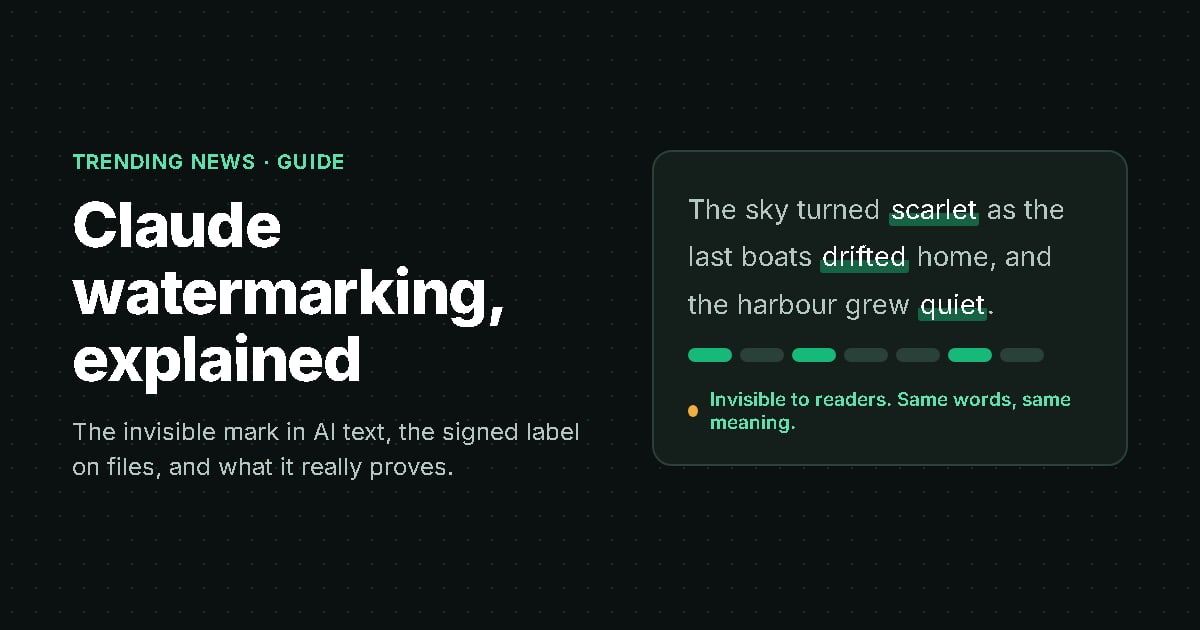
To understand the watermark, it helps to know how Claude writes. A language model builds its answer one small piece (a "token", roughly a word or part of a word) at a time. At each step there are usually several good options. If Claude is describing a sunset, "red", "scarlet" and "crimson" might all fit. Normally the model picks among the good options with a bit of randomness, which is why asking the same question twice gives slightly different answers.
The watermark replaces that randomness with something that only looks random. Instead of rolling dice, Claude uses a secret key together with the words that came just before to decide which of the good options to take. To a reader, the choice is just as natural as before. To someone holding the key, the pattern of choices across a whole passage is measurable, and a detector can score how likely it is that Claude produced the text.
Anthropic says its method is a version of SynthID-Text, an approach Google DeepMind published in the journal Nature in 2024, and part of a family of ideas going back to a 2022 proposal by the computer scientist Scott Aaronson. Two details matter for anyone worried about quality:
- It never pushes Claude toward a word it wouldn’t already consider. The key only decides between options that were already likely. Anthropic points to the SynthID-Text research, where people rated watermarked and normal answers the same, and to its own testing showing no effect on content, creativity or readability.
- Nothing is added to the text. There are no hidden characters, no extra tokens and no change to formatting. You can’t find the watermark by copying the text into a plain-text editor, because there is nothing extra to find. That also means no extra cost and no noticeable slowdown.
Because the mark lives in the pattern of choices, the more freedom Claude has, the stronger it is. A short story is full of choices. Code has far fewer: there is usually one right way to write total = price * quantity, so code is lightly watermarked, mostly in comments and names. The same goes for facts with only one correct answer, such as a date or a name. And if you ask for an exact output, there is nothing to choose and nothing to mark.
Can you see or remove the watermark?
You can’t see it. There is no telltale phrase, punctuation habit or invisible character to look for, and the text reads the same as unmarked text. Anthropic is also clear that the mark is a different thing from "AI detector" tools that guess from writing style. Those look for patterns humans associate with AI writing; the watermark is a statistical signal that only a detector with Anthropic’s key can check.
The watermark survives copy and paste, and Anthropic says it may survive some editing. Light edits probably leave enough of Claude’s choices in place to detect; a full rewrite in your own words removes it, because the choices are then yours. Translation is an interesting case: if you ask Claude to translate, the translated text carries the mark, because Claude chose every word of it.
Anthropic lists the usual reasons a mark may be missing or too weak to detect:
- the text came from an older model that isn’t covered yet;
- it was heavily edited, paraphrased, translated by something else, or mixed with other writing;
- the passage is very short, so there aren’t enough choices to measure;
- for files, the metadata was stripped by converting, re-saving or screenshotting;
- the platform or file type isn’t supported;
- on some older models, the request changed the sampling settings (see the developers’ section below).
What does a Claude watermark prove, and what doesn’t it?
This is the part most worth understanding, because it is easy to misread. A detected watermark means Claude was probably involved with the text at some point. That is all. Anthropic describes it as not fully conclusive, and gives the reasons:
- It can’t tell "wrote" from "helped". If you write a draft and ask Claude to polish, summarise or translate it, the result can be marked. The watermark cannot say whether Claude wrote it from scratch or edited your work.
- It doesn’t prove a human wrote anything. Detection answers one question: how likely is it that this was at least partly written by Claude? It can’t confirm human authorship, and it can’t tell you whether some other AI wrote the text.
- It says nothing about ownership. A watermark doesn’t change who owns the words, who is responsible for them, or your rights under Anthropic’s terms.
- It needs length. Detection works poorly on a sentence or two and gets more confident as the passage grows.
There is a privacy point here too. The watermark carries no information about you: not your name, your organisation, your account or your conversation. Nothing in the mark or its key can be used to trace text back to a person. It only answers "was Claude probably involved?"
For teachers, editors and managers, the honest takeaway is that a watermark is a provenance signal, not a verdict. It can start a conversation; it shouldn’t end one. Plenty of acceptable uses of AI (checking spelling, tidying a paragraph, translating a message) will leave a mark, and plenty of AI-written text won’t carry Claude’s.
Which Claude models are watermarked?
Any Claude model launched on or after 2 August 2026 has the text watermark from day one. According to Anthropic’s help article, that includes the current families: Fable 5.1 and 5, Mythos 5.1, Opus 5.5, Opus 5 and Opus 4.8, Sonnet 5.5 and Sonnet 5, and Haiku 5.5. Older models are being brought in over the coming months:
- From 3 November 2026: Mythos 5, Opus 4.7 and Sonnet 4.6 were added, with Amazon Bedrock catching up by 10 November for Mythos 5 and Opus 4.7.
- From 16 November 2026 (reported): Opus 4.6, Opus 4.5, Sonnet 4.5 and Haiku 4.5, according to an Anthropic email to API customers reported by The Decoder. Opus 4.6 had been planned for 3 November and slipped. Anthropic’s help page already lists these models, so check it for the latest status.
Models older than these may never be covered. If you need to know exactly which model produced something, the model name is the first thing to check.
What is the C2PA label on Claude files?
Text is only half the story. When Claude creates a supported file, Anthropic attaches a Content Credential: a small, cryptographically signed note in the file’s metadata, following the open C2PA standard (from the Coalition for Content Provenance and Authenticity, which many camera makers, software companies and news organisations use). Unlike the text watermark, it isn’t hidden; it is a standard label that any C2PA tool can read.
The signed note says Anthropic issued it, when, and that Claude provided the file at someone’s request and may have created or changed its contents. Like the text mark, it records nothing about the user, the organisation or the request, and it doesn’t change what the file looks or sounds like. Anthropic’s examples are PNG, JPEG and SVG images. For developers, the API documentation goes further: files that Claude produces in the code execution sandbox and that you download through the Files API are signed when they are images, video or audio, in formats from PNG, JPEG, GIF, WebP, TIFF, HEIC, AVIF and SVG to MP4, MOV, MP3, WAV, FLAC and M4A. Text files, PDFs and office documents aren’t signed.
The weakness of any metadata label is that it is easy to lose. Re-encoding an image, converting it to another format, taking a screenshot or running it through a metadata-stripping tool removes the credential. So, as with text, a missing label doesn’t mean a file wasn’t made with Claude.
How can you check if something was written by Claude?
For files, it is already possible. Anthropic offers a free Claude Content Checker where you drop in a file to look for a Claude-issued Content Credential, and any C2PA-compatible tool (such as the open-source c2patool) can read the label too.
For text, there is no public checker yet. Anthropic’s watermark detection API is in a private preview for organisations with a clear public-interest need: regulators, law enforcement, media and fact-checkers, independent researchers, educational organisations and civil society groups in the EU, plus companies that need to check their own Claude output for EU compliance. Eligible organisations can apply through a form linked from Anthropic’s help article, and Anthropic says it plans to widen access over time.
Until then, be wary of any website or app that claims to "detect the Claude watermark". Without Anthropic’s key, nobody can read it. Style-based AI detectors are a different, much less reliable thing.
Why is Anthropic watermarking Claude? The EU AI Act
The trigger is European law. Article 50 of the EU AI Act requires providers of AI systems that generate text, images, audio or video to mark that output in a machine-readable way so it can be identified as AI-made, and those transparency rules apply from 2 August 2026. In July 2026 Anthropic signed the EU’s Code of Practice on transparency of AI-generated content, which sets out how providers can meet the Article 50 duty. Anthropic says the Code has around 190 signatories. Models already on sale before August get a transition period, which is why older Claude models are being retrofitted rather than switched over at once.
Anthropic is not alone. Google has used SynthID across its own AI products for some time, and C2PA labels have been spreading through image tools and cameras for several years. What makes the Claude change notable is its reach: it covers ordinary text, worldwide, in a tool many businesses use every day, and it can’t be turned off.
Can you turn off Claude’s watermark?
No. There is no setting, plan or API option to switch it off, and Anthropic has said customers can’t disable it. Paying for a higher plan doesn’t change this, and neither does using Claude through a cloud provider.
Some people find that uncomfortable, and the reaction online has been mixed: some users dislike the idea of a hidden signal in their work, while others see it as a reasonable answer to a flood of unlabelled AI content. Researchers have also shown, for watermarking schemes in general, that determined attackers can sometimes weaken or imitate marks. Nobody has publicly shown such an attack on Claude’s scheme as of this writing, but the practical lesson is the same one Anthropic gives: treat the watermark as one useful signal, not as proof.
What should developers using the Claude API know?
If you build with the Claude API, most of this happens without you doing anything. Pricing, request formats and response formats are unchanged, and signed files need no new code. A few points are still worth knowing:
- Sampling settings matter on some older models. For Opus 4.6 and Sonnet 4.6, Anthropic says output may not reliably carry the text watermark if you set
temperature,top_portop_kto anything other than the default. Anthropic’s emails, as reported, extend the same caveat to Opus 4.5, Sonnet 4.5 and Haiku 4.5. If you rely on Claude’s watermark for your own compliance, leave those settings at their defaults on these models. - Keep files intact. If you pass Claude-made images or media on to your users, avoid re-encoding or stripping metadata if you want the Content Credential to survive.
- Check your own obligations. If you put Claude inside your own product, Anthropic says you should work out for yourself what Article 50 requires of you; its watermark may help, but it doesn’t automatically make your product compliant. Anthropic has promised more technical guidance on marking and detection as it becomes available.
- Don’t build on detection yet. With text detection in private preview, plan your product without it unless you have access.
Does the watermark affect websites built with AI, or SEO?
This is the question we get most from business owners, because more and more websites are written with AI help, including the ones built with Type An App. Here is the honest answer as of today.
Your site reads and works exactly the same. The watermark doesn’t add characters, change formatting or alter the meaning, so visitors see the same words, and your page speed, layout and code are untouched. Code carries very little watermark anyway.
There is no sign search engines use it. Text detection needs Anthropic’s key and is in private preview for regulators, researchers and similar groups. No source suggests Google, Bing or AI search tools read Claude’s watermark to rank pages. Google has long said it judges content on whether it is helpful and original, not on how it was produced. Our advice hasn’t changed: write (or edit) pages that genuinely answer your customers’ questions, add your own details, prices, photos and experience, and keep them up to date. That is what ranks, and it also makes the page more yours.
Editing makes the words yours. Every word you rewrite is your choice, not Claude’s. Most business owners change their AI-written first draft anyway, adding the details only they know, and that is good practice for reasons that have nothing to do with watermarks.
What this means for Type An App users
At Type An App we use Anthropic’s Claude to build your app and write its first text, and OpenAI’s models to make pictures and logos (as listed on our security page). So:
- Words Claude writes for your site (headlines, page text, product descriptions) may carry Claude’s text watermark, wherever the model we use is covered. Text you type or edit yourself does not.
- Pictures on your site come from OpenAI’s image models, not Claude, so Claude’s Content Credentials don’t apply to them. OpenAI has its own provenance labelling for images.
- The watermark holds nothing about you, your business or your customers, and there is nothing you need to switch on, off or change.
- We never use your apps, content or chats to train AI models.
The bottom line
Claude’s watermark is real, invisible and permanent: newer Claude models mark the text they write, and Claude-made images and media carry a signed label. For everyday users, almost nothing changes: the words read the same, cost the same and hold no personal data. What changes is that, over time, regulators, researchers and newsrooms will be able to tell that Claude was likely involved in a piece of text. That is useful, but it is a signal, not proof of who wrote what. The best response for a business is the same as before: use AI to get a strong first draft, then make it unmistakably yours.
Sources
- Anthropic Help Center: How Claude marks AI-generated content (models, products, limits, detection access).
- Anthropic: Claude’s text watermark (published 14 August 2026, updated 1 September 2026; how it works, SynthID-Text, privacy).
- Claude Platform docs: Content Credentials on generated files (file types, the Files API, verifying with C2PA tools).
- The Decoder: Anthropic’s text watermark is easy to bypass on several older Claude models (31 October 2026, updated 4 November 2026; the 16 November date and sampling caveat, from Anthropic’s emails).
- The Register: Anthropic pledges to embed watermarks (11 August 2026).
- Dathathri et al., Scalable watermarking for identifying large language model outputs, Nature, 2024 (SynthID-Text).
Frequently asked questions
Does Claude watermark its text?
Yes. Claude models launched on or after 2 August 2026 weave an invisible watermark into the words they choose, and Anthropic is adding it to older models through November 2026. It applies in every Claude product and on the API, worldwide.
Can you see the Claude watermark or remove it?
You can’t see it: there are no hidden characters and the text reads the same. It survives copy and paste and may survive light editing, but rewriting the text in your own words removes it, because the word choices are then yours.
Can I turn off Claude’s watermark?
No. There is no setting, plan or API option to disable it. On a few older models (such as Opus 4.6 and Sonnet 4.6) changing temperature, top_p or top_k can stop the mark being applied reliably, which is a known gap rather than an off switch.
Does the Claude watermark contain personal information?
No. Anthropic says the watermark carries nothing about you, your organisation or your conversation. It can only indicate that Claude was probably involved with the text.
How do I check if text was written by Claude?
There is no public tool for text yet. Anthropic’s detection API is in private preview for regulators, researchers, media, educators and similar groups. For images and other files, the free Claude Content Checker or any C2PA tool can read Claude’s Content Credential.
Will the Claude watermark hurt my website’s SEO?
There is no sign it does. Detection needs Anthropic’s key and isn’t public, and search engines have said they judge content on helpfulness, not on how it was made. Adding your own details and editing AI drafts is still the best way to rank.
Matthew, Developer: Matthew builds Type An App, the AI app builder that turns a plain-words idea into a working website or app. He writes up every showcase build here: what we asked for, what came back, and what we changed.