Top tech companies leading in AI development – Full breakdown
By Matthew, Developer · · 10 min read
In short: AI is built in layers: chips, cloud data centres, AI models, and the apps people use. OpenAI, Google, Anthropic and Meta lead on models; NVIDIA on chips; Microsoft, Amazon and Google on cloud; and Apple, Microsoft and Google put AI into devices and everyday software. For a small business, the useful question is not who is "winning" but which tools put that AI to work for you.
Every week brings a new AI announcement, and the same handful of company names keep coming up. If you run a small business, it is fair to wonder which of them actually matter to you, and what they each do. This guide is a calm, plain-words map: what "leading in AI" really means, what each of the big names builds, and what it means for a business like yours.
What does "leading in AI development" actually mean?
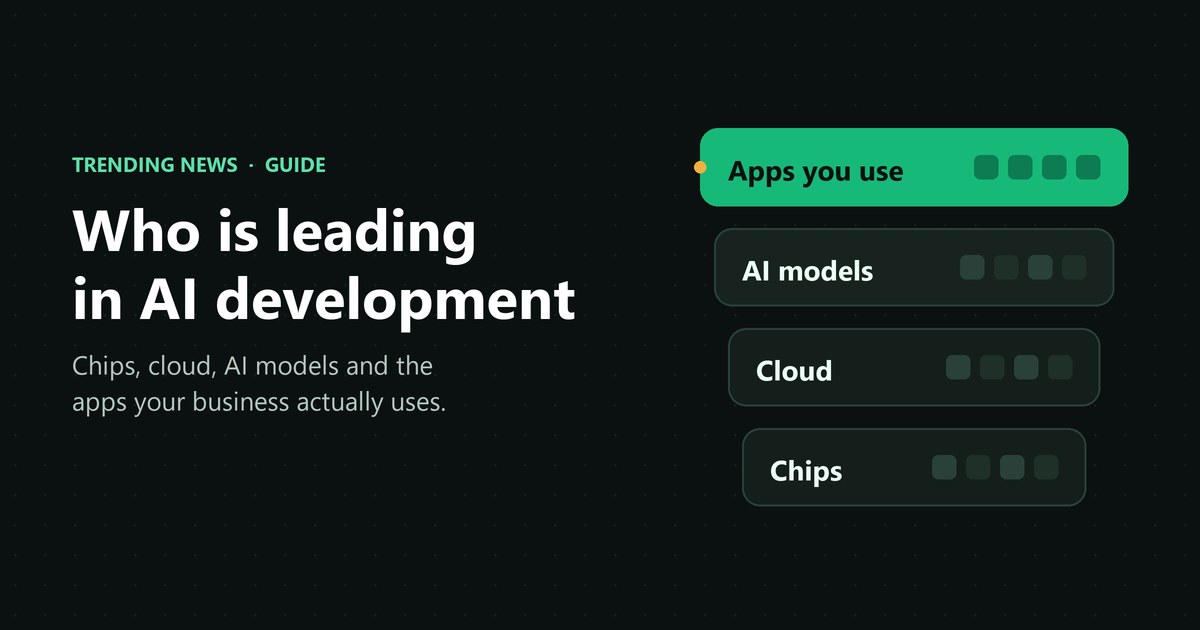
There is no single AI race. Think of AI as a stack of four layers, each one built on the one below. A company can lead in one layer and simply be a customer in another.
- Chips. AI is trained and run on specialised processors, mostly graphics chips (GPUs) and custom AI chips. Without them, nothing else happens.
- Cloud and infrastructure. Huge data centres full of those chips, rented out by the hour. This is where most AI models are trained and where most AI apps run.
- AI models. The "brains": large language models that read and write text, plus models for pictures, speech and video. Training a leading model takes enormous computing power and specialist research teams.
- Products and apps. The things people actually touch: chat assistants, AI in email and documents, phone features, and apps built on top of the models, including the ones small businesses use every day.
With that map in mind, here is who does what.
OpenAI: ChatGPT and the GPT models
OpenAI is the company behind ChatGPT, the chat assistant that brought AI into everyday conversation when it launched in late 2022. It builds the GPT family of language models and also makes models for pictures, speech and video. Businesses use its models in two ways: through ChatGPT itself, and through its developer platform, which lets other software (including apps you may already use) build on its models.
Known for: making AI chat a household idea, and a fast pace of new releases. Microsoft is a long-standing investor and partner, which is why OpenAI models show up across Microsoft products.
What it means for you: ChatGPT is a handy everyday assistant for drafting emails, product descriptions and social posts. Many of the AI features inside other tools are powered by OpenAI models behind the scenes.
Google: Gemini and Google DeepMind
Google has done AI research for well over a decade. The 2017 research paper that introduced the transformer, the design behind today's large language models, came from Google researchers. Its AI lab, Google DeepMind, is known for research breakthroughs such as AlphaFold, which predicts the shapes of proteins and is widely used by scientists.
Today Google's main family of models is Gemini. It powers the Gemini assistant, AI features in Google Search, and AI in Gmail, Docs and the rest of Google Workspace. Google also designs its own AI chips (TPUs) and sells AI services to developers through Google Cloud, so it plays in every layer of the stack.
What it means for you: if your business runs on Gmail and Google Docs, you are probably already a click away from Gemini. And how Google Search presents AI answers is worth watching, because it affects how customers find you.
Microsoft: Copilot and Azure
Microsoft leads less by making headline models of its own and more by putting AI everywhere people already work. Copilot is its name for AI assistance across Windows, Word, Excel, Outlook, Teams and more, and GitHub Copilot helps software developers write code. Its cloud, Azure, rents out AI computing and offers a catalogue of models, including OpenAI's, to businesses that want to build their own tools.
What it means for you: if your team lives in Microsoft 365, Copilot is the most direct way to try AI on your existing documents, spreadsheets and meetings, with your current sign-in and security settings.
Anthropic: Claude
Anthropic was founded in 2021 by a group of former OpenAI researchers and builds the Claude family of AI models. It puts a strong public focus on AI safety research, and Claude is widely used for writing, analysis and especially for writing software. You can use Claude through its own apps and developer platform, and through Amazon's and Google's clouds. Amazon and Google are both investors.
Anthropic also introduced the Model Context Protocol (MCP), an open standard that lets AI assistants connect safely to other tools and data. It has since been adopted well beyond Anthropic, which is a big part of why AI assistants can now "plug in" to the software you use.
What it means for you: Claude is a strong choice for long documents, careful writing and anything involving code, and it is one of the models doing the work inside many AI products, including ours (more on that below).
Meta: Llama and open models
Meta, the company behind Facebook, Instagram and WhatsApp, takes a different approach: it releases its Llama models as open-weight models, which means anyone can download them and run them on their own computers or cloud, under Meta's licence terms. That has made Llama a popular base for other companies and researchers. Meta also created PyTorch, the free software toolkit that a large part of the AI world uses to build models.
For everyday users, Meta puts its assistant, Meta AI, inside WhatsApp, Instagram, Facebook and Messenger.
What it means for you: open models give businesses more choice and can lower costs over time, even if you never download one yourself. And if your customers message you on WhatsApp or Instagram, AI is already part of the apps they use to reach you.
NVIDIA: the chips underneath it all
NVIDIA started out making graphics chips for video games. Those same chips turned out to be very good at the kind of maths AI needs, and NVIDIA's GPUs, together with its CUDA software that developers program them with, became the standard tools for training and running AI. A large share of the models in this guide were trained on NVIDIA hardware, and all of the big cloud companies rent out NVIDIA chips.
What it means for you: you will probably never buy an NVIDIA AI chip, but the supply and price of those chips shape what AI costs and how quickly new features arrive in the tools you do use.
Amazon: AWS, Bedrock and Alexa
Amazon's biggest role in AI is through Amazon Web Services (AWS), one of the largest cloud providers. Its Amazon Bedrock service lets businesses use models from several companies, including Anthropic, Meta, Mistral and Amazon's own models, from one place. Amazon also designs its own AI chips (Trainium and Inferentia) to run AI more cheaply in its data centres.
On the consumer side, Amazon is rebuilding its Alexa voice assistant around newer generative AI, and it uses AI throughout its shopping site, for example to summarise product reviews.
What it means for you: if you sell on Amazon or your website runs on AWS, you're already using Amazon's AI infrastructure. Bedrock's "many models in one place" approach is also a sign of where things are heading: businesses mixing models rather than picking just one.
Apple: Apple Intelligence
Apple's approach to AI is built around privacy and the device in your hand. Apple Intelligence brings writing tools, summaries of notifications and messages, image features and a more capable Siri to recent iPhones, iPads and Macs. Where it can, it runs AI on the device itself; heavier requests go to what Apple calls Private Cloud Compute, servers that Apple says are designed not to keep your data. Apple has also let Siri hand some questions to ChatGPT when you choose to.
What it means for you: if you and your customers use Apple devices, everyday AI help (tidying an email, summarising a long thread) is arriving built in, without a separate app or account.
Who else is worth watching?
- Mistral AI, a French company, builds both open and commercial models and is a leading name in European AI.
- xAI, Elon Musk's AI company, makes the Grok models and assistant, which is built into the social network X.
- DeepSeek, a Chinese AI lab, drew worldwide attention in early 2025 with capable open-weight models that it said were trained at a fraction of the usual cost.
There are many more, from AI-first start-ups to the software companies you already pay for, most of which now build on models from the companies above.
Where TypeAnApp fits: AI development for everyone
To be clear about our place in the stack: TypeAnApp does not make AI models or chips. We're in the top layer. We take the leading models and turn them into something a business owner can use without writing code: your own website or app, built from a description in plain words. We use Anthropic's Claude to build apps and answer questions, and OpenAI's models for pictures and logos. Neither company sponsored this post, and we don't use your apps, content or chats to train AI models.
Here is what that means in practice:
- Describe it, get it. Type something like "a booking site for my dog-grooming salon, with online payments" and TypeAnApp builds a working website, online store, booking app, client portal or CRM. You keep shaping it by chatting, and see every change in a live preview.
- A real app, not just pages. Each app comes with a database, customer sign-in and email, and can take card payments through Stripe, straight into your own Stripe account.
- AI inside your app. Your app can write or answer text for your customers, and on paid plans you can add agents: digital helpers that do jobs by themselves, like drafting replies to new enquiries every morning. They never delete your records and never email your customers.
- Workflows and integrations. On paid plans your app can post to Slack, Discord or Telegram, send email from Gmail, send WhatsApp messages, save files to Google Drive, add rows to Google Sheets and keep HubSpot up to date.
- Your brand and your address. Make a logo in the Logo Studio, then launch at a free typeanapp.app address, or, on paid plans, on your own domain: connect one you already own or buy a new one from us.
- Safe to launch. Every app gets a security check before it goes live, access rules are enforced on our servers, and the AI is never allowed to widen who can see your data without your approval.
- In your language. TypeAnApp works in eight languages: English, German, Spanish, French, Japanese, Portuguese, Polish and Dutch.
- From the AI tools you already use. On the Basic plan and up, you can build and change your apps from Claude, ChatGPT, Cursor and other AI tools, through the same Model Context Protocol mentioned above.
Not ready to build yet? Our free tools need no sign-up: a website grader that checks your current site, a business name and domain checker and a logo maker.
What should a small business do with all this?
- Don't pick a winner. The lead changes often, and most good tools let you benefit from several companies' models at once.
- Start with a job, not a model. "Answer enquiries faster" or "take bookings online" is a better starting point than "which AI is best?".
- Use what you already have. Gemini in Google Workspace, Copilot in Microsoft 365 and Apple Intelligence on your phone may already be included in what you pay for.
- Check where your data goes. Read how a tool uses your information, and prefer ones that say they don't train AI on your content.
- Build what is missing. When no off-the-shelf tool fits how your business works, an AI app builder can make one that does.
Frequently asked questions
Which company is leading in AI development?
There is no single leader, because AI has several layers. As of October 2026, OpenAI, Google, Anthropic and Meta are best known for AI models; NVIDIA for the chips AI runs on; Microsoft, Amazon and Google for the cloud; and Apple, Microsoft and Google for putting AI into devices and everyday software.
What is the difference between an AI model and an AI app?
An AI model is the "brain" that reads and writes, such as GPT, Gemini, Claude or Llama. An AI app is the product you use, such as a chat assistant or a booking system, which sends your request to a model and does something useful with the answer.
What are open-weight AI models?
Models whose trained "weights" are published, so anyone can download and run them on their own computers or cloud, under the maker's licence. Meta's Llama, and models from Mistral and DeepSeek, are well-known examples.
Why does NVIDIA matter if it does not make chatbots?
Because most AI is trained and run on its chips (GPUs) and the CUDA software that programs them. Their supply and price shape how much AI costs and how fast new features arrive.
Does TypeAnApp make its own AI model?
No. TypeAnApp is an AI app builder: we use Anthropic's Claude to build apps and answer questions, and OpenAI's models for pictures and logos, so you can get a working website or app from a plain-words description without writing code.
Can a small business use AI without hiring a developer?
Yes. Start with the AI already in tools you use, like Google Workspace, Microsoft 365 or your phone. For your own website, online store or booking app, TypeAnApp builds it from a description, and you can start free.
Matthew, Developer: Matthew builds TypeAnApp, the AI app builder that turns a plain-words idea into a working website or app. He writes up every showcase build here: what we asked for, what came back, and what we changed.